INTRODUCTION
Malaysia, as a tropical country with extensive forest resources, has long regard its natural forests as a key national asset supporting both economic development and environmental sustainability. The Malaysian government continues to uphold its commitment made at the 1992 Earth Summit in Rio de Janeiro, Brazil to maintain at least 50% of the country’s land area under forest and tree cover[1]. At the
same time, the country needs to manage competing pressures from key industries such as palm oil, timber and mining, which remain important contributors to the national economy and to rural livelihoods[2].
The timber sector continues to play a significant role in Malaysia’s economy. The industry includes the processing, manufacturing and export of wood-based products such as wooden furniture, plywood, veneer and other timber components[3]. In 2024, timber exports reached approximately USD5.01 billion (RM22.92 billion), marking a 5% increase from the previous year. Between January and August 2025, exports were valued at USD3.45 billion (RM14.49 billion), generating a trade surplus of RM8.60 billion[4]. Beyond its economic contribution, Malaysia’s forests are increasingly recognised for their broader environmental value, particularly as global attention on climate change and biodiversity continues to grow.
Malaysia’s forests play an important role in offsetting the country’s greenhouse gas (GHG) emissions and are becoming increasingly relevant in the context of emerging carbon credit markets. In 2021, Malaysia recorded total GHG emissions of 364,490 Gg carbon dioxide equivalent (CO e), with carbon sinks from the land use, land use change and forestry (LULUCF) sector offsetting 68% of these emissions, largely due to existing forests[5]. However, forest loss remains a challenge, with approximately 3.0 million hectares of humid primary forest lost between 2002 and 2024[6]. In response, forestation initiatives are receiving greater attention. These typically includes afforestation which refers to the direct human-induced conversion of land that has not been forested for at least 50 years into forested land, while reforestation refers to the direct human-induced conversion of non-forested land to forested land on land that was previously forested but has since been converted to non-forest use. Both are typically carried out through planting, seeding and/or the human induced promotion of natural seed sources[7]. These approaches are increasingly viewed as important tools for strengthening carbon sinks and supporting nature-based carbon credit projects.
FOREST CONSERVATION AND RESTORATION INITIATIVES
In response to the challenges, Malaysia has introduced several national initiatives aimed at strengthening forest conservation and expanding green cover across the country. One example is the Greening Malaysia Programme through the 100 Million Tree-Planting Campaign, a five-year initiative launched in 2021 by the Ministry of Natural Resources, Environment and Climate Change (formerly
known as Ministry of Energy and Natural Resources). The campaign was designed to raise public awareness of the importance of forest areas while supporting Malaysia’s commitment to maintain forest cover[8]. The programme reached its target ahead of schedule in 2024 and has contributed to efforts to raise awareness on the importance of green cover as well as to improve ecosystems and support biodiversity across the country[9].
Malaysia also participates in international efforts aimed at reducing emissions from the forest sector through the REDD+ framework under the United Nations Framework Convention on Climate Change (UNFCCC)[10]. REDD stands for “Reducing Emissions from Deforestation and Forest Degradation” in developing countries, while the “+” refers to additional forest-related activities that support climate protection, including the sustainable management of forests and the conservation and enhancement of forest carbon stocks. Under the framework, developing countries that successfully reduce emissions from deforestation may receive results-based payments for emission reductions, creating financial incentives to strengthen forest conservation while contributing to global climate goals[11].
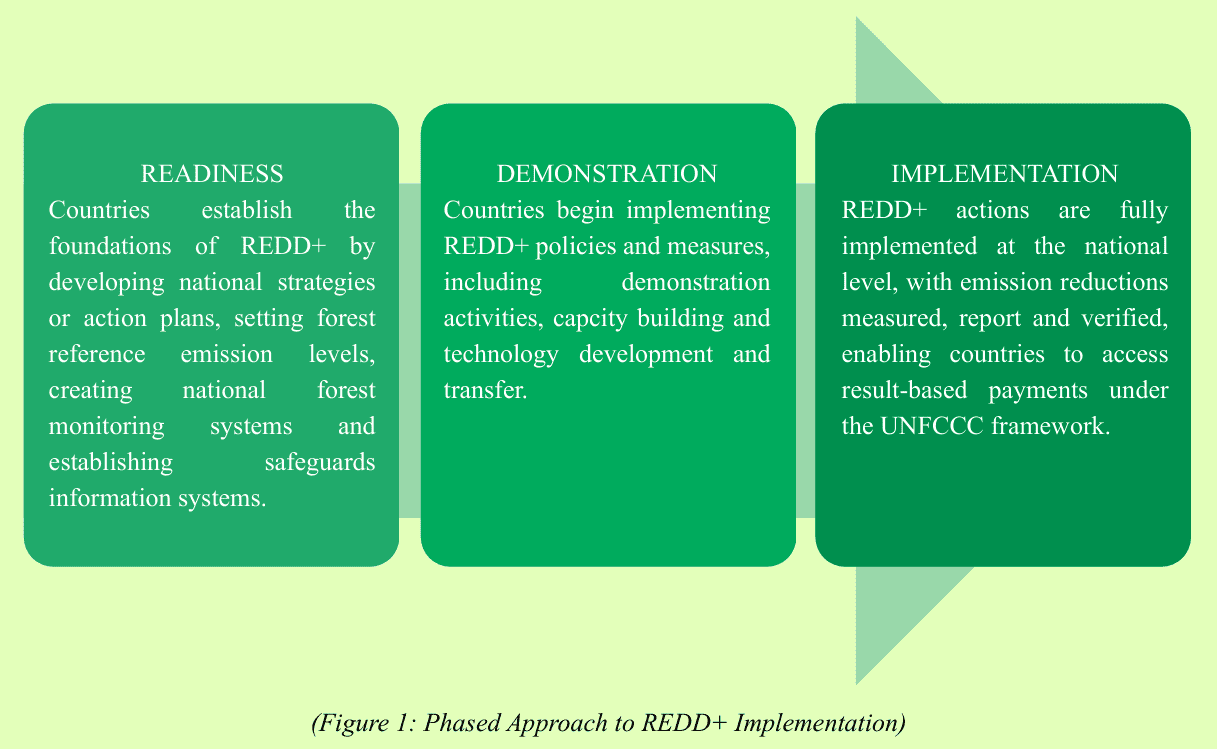
The implementation of REDD+ is guided by the Warsaw Framework, which sets out the international rules and guidance for REDD+ actions to be recognised under the UNFCCC and to qualify for result based financing[12]. The framework outlines key requirements for participating countries, including development of national strategies, forest reference levels, monitoring systems and safeguards[10]. In its submissions to the UNFCCC, Malaysia has reported the development of a National REDD+ Strategy, the establishment of a National Forest Reference Level and the reporting of safeguards for REDD+ implementation[13]. REDD+ implementation typically progresses through a phased approach, as illustrated in the flowchart below[10]:
In parallel, initiatives are being developed to finance and support the implementation of forest-based climate projects, as aligned with REDD+ objectives. The Malaysia Forest Fund (MFF), which enacts the REDD+ financial framework signed a memorandum of understanding (MOU) with Petronas to explore the development of nature-based solutions projects in Malaysia, including initiatives focused on conserving and restoring the natural ecosystems[14]. MFF has also entered into a similar collaboration with Yinson Holdings Berhad to explore the development and scaling up of nature-based solutions projects, aimed at connecting landowners, nature-based solutions developers and investors while supporting conservation and management of tropical lands and sustainable land management[15]. Such obligations highlight growing interest from both the public and private sectors in supporting forest-based climate initiatives.
Alongside government-led frameworks, voluntary carbon market standards play an important role in translating forest conservation activities into tradable carbon credits. One of the most widely used standards globally is the Verified Carbon Standard (VCS) Programme developed by Verra, which provides methods for validating and verifying emission reductions from forest conservation projects[16]. Verra has developed methods specifically for REDD activities, as well as projects aimed at avoiding unplanned deforestation, which refers to the direct human-induced conversion of forest land to non-forest land[17]. These methods provide a structured approach for establishing project baselines, monitoring deforestation risks and verifying emission reductions before carbon credits are issued[18]. As voluntary carbon markets continue to evolve, such standards may provide a pathway for forest-based projects, including those aligned with REDD+ objectives, to generate high-integrity carbon credits.
VOLUNTARY CARBON MARKET IN MALAYSIA
A number of forest-based projects in Malaysia have already been developed or proposed under Verra’s VCS framework. Among them is the Kuamut Rainforest Conservation Project in Sabah, which aims to protect and restore approximately 83,381 hectares of tropical forest within the Tongod and Kinabatangan districts. The project is registered under the VCS Programme. The project area was previously designated as production forest that had been repeatedly logged. By preventing further commercial logging over a 30-year period, the project is expected to avoid the release of approximately 16 million tonnes of COe[19]. In Peninsular Malaysia, the Pahang Peatland Restoration Project (PPRP) seeks to restore and conserve around 96,569 hectares of peatland and wetland ecosystems, the largest continuous peat and wetland landscape in the region. The project is currently under validation under the VCS Programme. The project focuses on peatland restoration, fire prevention, improved forest monitoring and sustainable community livelihoods and is expected to avoid approximately 132.5 million tonnes of COe emissions over its project lifetime, while also generating additional carbon removals through ecosystem restoration[20].
Together, these projects illustrate how forest conservation and restoration initiatives in Malaysia are beginning to translate into measurable emission reductions and potential carbon credit generation under internationally recognised standards. In July 2024, carbon credits generated from the Kuamut Rainforest Conservation Project were also featured in the first Malaysian nature-based carbon credit auction conducted by Bursa Carbon Exchange (BCX), where the auction cleared at RM50 per contract and attracted participation from several Malaysian corporates[21].
The development of forest conservation and restoration projects also reflects the broader growth of Malaysia’s voluntary carbon market ecosystem. As carbon credits generated from such initiatives gain recognition under internationally accepted standards, mechanisms are needed to facilitate the transparent trading and financing of these environmental assets. In Malaysia, this role is increasingly supported by the BCX, a platform operated by Bursa Malaysia Carbon Market Sdn. Bhd. that facilitates the trading of carbon credits and renewable energy certificates (RECs) through standardise contracts. Launched as the world’s first Shariah-compliant multi-environmental products exchange, BCX enables companies to participate in climate mitigation efforts by purchasing carbon credits from projects that deliver measurable emission reductions and sustainable development outcomes[22].
In addition, expectations around corporate climate transparency are evolving in Malaysia. To ease the adoption of sustainability reporting and provide consistency with global practices, the National Sustainability Reporting Framework (NSRF), which was developed by the Advisory Committee on Sustainability Reporting, with the endorsement of the Ministry of Finance, aims to streamline the preparation of sustainability statements by listed issuers[23]. In line with this, Bursa Malaysia has amended its listing requirements to mandate sustainability reporting using the IFRS Sustainability Disclosure Standards (IFRS S1 and IFRS S2). These standards enhance disclosure on sustainability related risks, opportunities and climate-related information, fostering greater transparency and comparability for investors[24]. In this context, participation in the voluntary carbon market is increasingly aligned with emerging disclosure requirements and corporate climate strategies.
To support the integrity and development of Malaysia’s voluntary carbon market. Bursa Malaysia and related institutions are working with internationally recognised carbon standards and policy initiatives. Key developments supporting the carbon market ecosystem are summarised below:
| INITIATIVES | INSTITUTIONS INVOLVED | PURPOSES |
|---|---|---|
| Alignment with Verra VCS Programme via MOU in 2024 | MFF & Verra | Explore alignment between Malaysia’s forest carbon initiatives and the VCS Programme, including potential integration of Malaysia’s Forest Conservation Certificate (FCC) and Forest Carbon Offset (FCO) standards [25]. |
| Gold Standard Collaboration via MOU at COP28 | BCX & Gold Standard | Support the development of Malaysia’s voluntary carbon market through capacity building and the establishment of validation and verification capabilities [26]. |
| Carbon Tax Announcement via Budget 2025 | Government of Malaysia | Proposed carbon tax on iron, steel and energy industries by 2026, with tax proceeds supporting green technology research and programmes [27]. |
POLICIES AND LEGAL FRAMEWORK ON MALAYSIA FORESTATION
As forestation efforts gain greater attention in addressing forest loss and strengthening carbon sinks, the legal and policy framework governing forest management also plays an important role. In Malaysia, this framework has been strengthened through recent legislative reforms. On 1 February 2025, the National Forestry (Amendment) Act 2022 came into force, introducing amendments to the National Forestry Act 1984. The amendments aim to enhance the protection of forest resources, particularly Permanent Reserved Forests (PRFs), by tightening regulatory control and imposing stricter penalties for offences involving illegal logging and damage to forest areas[28]. Under Section 81(1) of the Act, activities such as the unauthorised cutting of trees or causing damage within PRFs are prohibited unless permitted by law[29]. Amendments to Section 81(2) increase the maximum fine from RM50,000 to RM100,000 and extend imprisonment terms from up to 5 years to up to 7 years, reflecting a stronger enforcement approach against forest-related crimes[28].
The governance of forests in Malaysia is shaped by the country’s federal system. Under Article 74(2) of the Federal Constitution, read together with the State List in the Ninth Schedule, forestry falls primarily under the jurisdiction of the State Governments [30]. Each state therefore has the authority to enact forestry laws and manage forest resources within its territory, including issuing licences and designating forest reserves[29]. The Federal Government plays a largely coordinating and supportive role by providing technical assistance, research and training. Coordination between the Federal and State Governments is facilitated through the National Land Council, which serves as a platform to discuss and align policies relating to land use and forestry management[30].
Beyond legislative reforms, Malaysia has also introduced broader policy frameworks to guide sustainable forest management. The Malaysia Forestry Policy (2021) sets out key principles and strategic directions for forestry development across the country, emphasising sustainable forest management, biodiversity conservation and climate change mitigation while supporting socio economic development[31]. Looking ahead, the 13 Malaysia Plan (2026-2030) outlines further measures to strengthen biodiversity conservation and ecosystem management. The plan promotes the use of nature-based solutions, including the restoration of mangrove forests and coastal ecosystems, with targets to restore approximately 4,300 hectares of mangrove and wetland areas[32].
Despite these initiatives, Malaysia continues to face structural challenges in implementing forest conservation and climate-related policies. While the Federal Government leads the development of national climate strategies and international commitments, the implementation of forest and land-use policies ultimately depends on individual states. This division of powers can lead to differences in regulatory approaches and policy adoption across the country. For example, amendments to strengthen forest protection under the National Forestry Act have only been adopted by Perlis and Selangor[33]. Such variations can create coordination challenges, particularly in emerging areas such as forest-based carbon markets where consistent standards and monitoring are important.
Malaysia has introduced measures to strengthen coordination and improve implementation. These include the establishment of a National Forest Monitoring System (NFMS) to support the measurement, reporting and verification of forest-related emissions and removals under international frameworks such as REDD+[34]. Financial mechanisms are also being used to encourage stronger state-level participation in conservation efforts. Since 2022, the Ecological Fiscal Transfer (EFT) has been managed by the Ministry of Natural Resources and Environmental Sustainability, with a greater portion of funding linked to performance indicators and compliance with national policies[35]. Under Budget 2025, the performance-based component of the EFT was increased from 30% to 50% [36], with new criteria including compliance with the National Forestry (Amendment) Act 2022 and recognition of Other Effective Area-based Conservation Measures (OECMs)[35]. These measures reflect ongoing efforts to strengthen forest governance while aligning conservation with climate and sustainable development goals.
REGIONAL FOREST CARBON PROJECTS
As global concern over climate change grows, many countries are turning to forest-based carbon initiatives as part of their climate strategies. In Southeast Asia, Indonesia is often cited as an example, having developed several large-scale forest conservation and REDD+ projects that generate verified carbon credits while protecting important ecosystems. Two notable initiatives are highlighted below:
Katingan Mentaya Project
Location: Central Kalimantan
Key features:
- A tropical peatland forest protection and restoration initiative that aims to prevent deforestation and forest degradation while restoring damaged ecosystems.
- The project focuses on activities such as replanting degraded areas and rewetting drained peatlands to prevent peat drainage, oxidation and forest fires, while delivering verified GHG emissions reductions[37].
Rimba Raya Biodiversity Reserve Project
Location: Central Kalimantan
Key features:
- Protects about 64,000 hectares of tropical peat swamp forest and is estimated to prevent nearly 130 million tonnes of carbon emissions[38].
- Developed by InfiniteEARTH, it also serves as a buffer for Tanjung Puting National Park and was the first validated REDD+ project under the VCS[39].
In October 2025, Verra and Indonesia’s Ministry of Environment/Environmental Protection Agency signed a Mutual Recognition Agreement (MRA) that allows carbon projects in Indonesia to be recognised under both Verra’s Verified Carbon Standard (VCS) Programme and the country’s national carbon registry. The agreement is intended to streamline project registration, improve transparency in tracking emissions reductions and encourage greater investment in Indonesia’s carbon market[40].
CONCLUSION
Malaysia’s forests continue to play an important role in the country’s environmental and climate strategy. Through various policies, national programmes and legal frameworks, the Malaysian government has taken steps to strengthen sustainable forest management and integrated forest conservation into broader climate mitigation efforts. Initiatives such as forest restoration programmes, national forestry policies and the development of carbon market mechanisms reflect a growing recognition of the role forests can play in supporting Malaysia’s climate commitments.
While challenges remain, particularly in the coordination of climate and forestry policies across federal and state levels, ongoing improvements in monitoring systems, financial incentives and policy alignment may help strengthen the implementation of forest-based initiatives. Looking ahead, Malaysia’s forest resources and evolving policy framework offer opportunities not only for increased participation in international climate initiatives and carbon markets, but also for innovation in nature based solutions, sustainable financing mechanisms and cross-sectoral collaboration. By continuing to align national forestry strategies with emerging global climate standards, Malaysia is well positioned to strengthen the contribution of its forests to long-term climate resilience, biodiversity conservation and sustainable development.
If you have any questions or require additional information, please contact Hua Sia Yen at yen@kaaplaw.com
CONTRIBUTORS: HUA SIA YEN (Partner) & WONG ZI YING (Associate)
LIST OF REFERENCES:
- Malaysia Policy on Forestry, page 2
- Malaysia National Climate Change Institutional Assessment – February 2026, page 30
- About the Malaysian Timber Industry
- Malaysia Timber Council Press Release – 10 November 2025
- Malaysia National Climate Change Institutional Assessment – February 2026, page 33
- Global Forest Watch – Malaysia
- VCS Program Definitions Version 5.0, page 2, 22
- Greening Malaysia – 100 Million Tree-Planting Campaign (2021–2025)
- 13th Malaysia Plan (2026–2030), page 5-21
- REDD Plus in Malaysia
- What is REDD+?
- Report on Summary of Information on How REDD+ Safeguards are Addressed and Respected
- REDD+ Data for Malaysia
- Media Release (31 May 2023) – PETRONAS Partners with Malaysia Forest Fund to Explore High-Quality Nature-Based Solutions Projects
- Media Release (10 June 2024) – Yinson signs MoU with Malaysia Forest Fund to explore Nature-based Solutions Projects
- Verified Carbon Standard (VCS) Programme
- VCS Program Definitions Version 5.0, page 7
- Setting the Standard: Verra’s Revolutionary New REDD Methodology
- Kuamut Rainforest Conservation Project
- Pahang Peatland Restoration Project
- Bursa Malaysia Media Release (25 July 2024) – BCX Auctions First Malaysian Nature-Based Carbon Credits
- Overview on Bursa Carbon Exchange (BCX)
- National Sustainability Reporting Framework (NSRF)
- Bursa Malaysia Media Release (23 December 2024) – Bursa Malaysia Requires Sustainability Reporting Using the IFRS Sustainability Disclosure Standards
- Verra and Malaysia Forest Fund Sign MOU to Align Country’s Forest Carbon Initiatives with Verified Carbon Standard Program
- Bursa Malaysia Media Release (11 December 2024) – BCX Expands Product Offerings with Gold Standard Carbon Credits
- Budget 2025 Malaysia, page 80 paragraph 144
- National Forestry (Amendment) Act 2022
- National Forestry Act 1984
- Federal Constitution of Malaysia, Article 74, 91, 94, Ninth Schedule
- Malaysia Policy on Forestry 2021
- 13th Malaysia Plan (2026–2030), page 5-21
- Malaysia National Climate Change Institutional Assessment – February 2026, page 82
- Measurement, Reporting and Verification (MRV) Framework
- Malaysia National Climate Change Institutional Assessment – February 2026, page 25
- Budget 2025 Malaysia, page 80 paragraph 145
- Katingan Mentaya Project
- Rimba Raya Biodiversity Reserve Project
- What is Rimba Raya?
- Verra and Indonesia Sign Milestone Agreement to Advance Carbon Markets